I was recently watching a YouTube video about what would happen if one were to strip a 1kg ball of metal completely of all electrons, you know, as you do. And the creator talked about how the ball would discharge into the capacitor formed by the Earth's atmosphere, which can significant- wait WHAT. The Earth's atmosphere is a capacitor??!
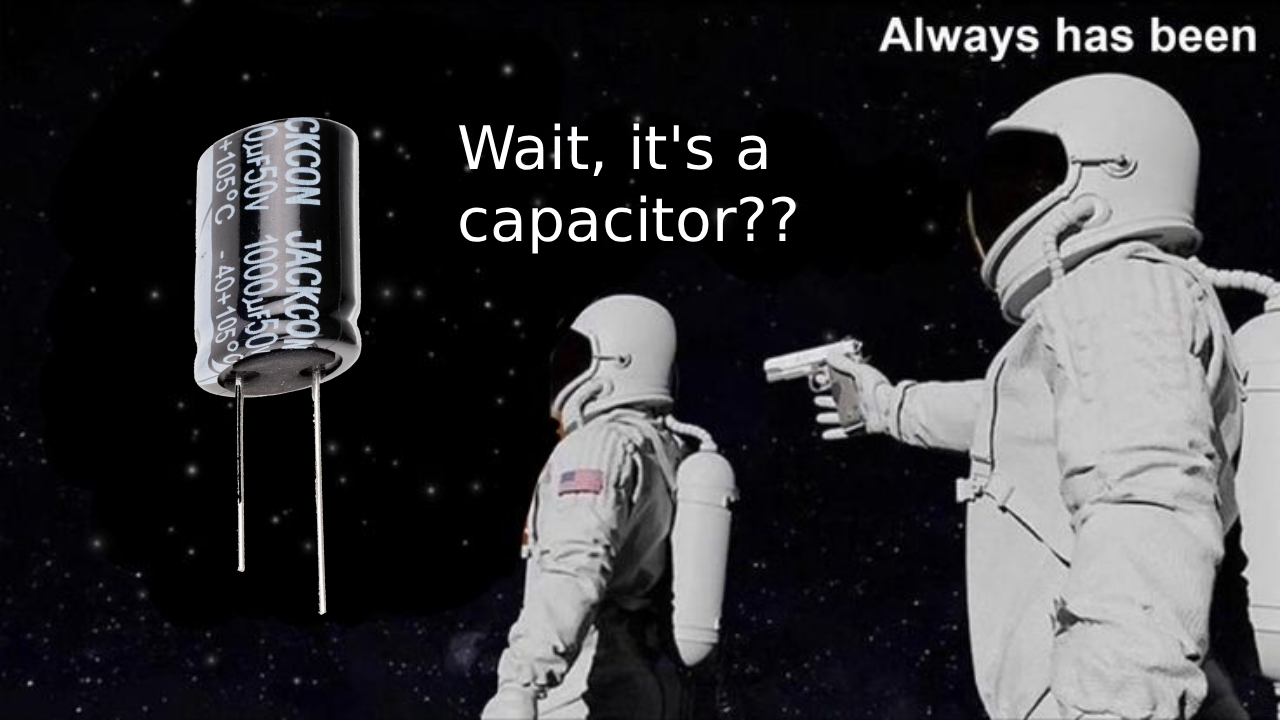
The Atmosphere Is A Capacitor
The solid surface of the planet, and the conductive part of the upper atmosphere (known as the ionosphere) are when you think about it, two planet-sized spherical-ish concentric conductive shells with a thin insulating atmosphere between them. That's a capacitor if I've ever seen one.
I found estimates online of this geopacitor (if I may) to have a capacitance of around ~0.8-0.9 farads. That's pretty substantial for a planet sized capacitor. The ionosphere ends sits at around +250 kV relative to the ground, maintained by weather phemonena (most significantly, thunder). That's about 2 . 10^5 couloumbs of charge. Because this charge is maintained by weather, it is possible to make a sentence like "the Sun turned our planet into a charged capacitor".
The atmosphere in between is not a perfect insulator of course, so you also have a DC current density of about 2 pA / m^2. That's still a kiloamp of DC current around the globe, we're talking about a planet's surface area after all.
On a clear day with fair weather, you would be sitting inside a ~100 V/m electric field pointing downwards. That sounds like a lot and it kind of is, but because the atmosphere is about seven orders of magnitude less conductive around the surface than higher up (around 80 km high), it doesn't accumulate to megavolts across the entire distance. It rapidly falls of as we go higher up. That's why a simple capacitor equivalent circuit isn't very truthful, a constant field equivalent thickness crunches out to be 2 km. The dominance of the lower atmosphere is very easy to see from that figure.
The capacitic behavior is very real though. People measured the 2022 Hunga Tonga volcanic lightning event and found that it acted like hitting the geopacitor with an impulse. A study even measured the RC decay time constant to be around 8 minutes. You can even estimate the global atmospheric resistance from this figure, it was found to be around 250 ohms. Wild!
And Other Strange Facts
The sheer scale of the system means it can have much more involved little bits of behavior that escape the simple lumped element lumped we know and love. For instance, and this is my favorite revelation of the whole thing, the ionosphere and the surface form a spherical cavity. At a planet's size, that's an ELF waveguide! Resonating with it is what allows waves of certain frequencies to circle the planet and interfere with themselves. This is known as Schumann resonance. The first few peaks are measured to be approximately $7.8,\;14.3,\;20.8,\;27.3,\;33.8\ {\rm Hz}$.
The first peak at $7.8 {\rm Hz}$ is quite a ways from the theoretical figure of $10.59 {\rm Hz}$ because a planet sized system is the epitome of non-ideal physics. Conductivity variations, huge losses, dispersions by all kinds of stuff mean the theoretical value is out of the window. Heck, even a thunderstorm can throw a planet sized wrench in the calculations.
Because thunder emits in a wide broadband, weather events constantly excite the atmosphere with Schumann resonance. This has formed a stable wave system that circles the planet, and gives rise to an average daily variation in the electric field in Universal Time that is globally coherent. The graph of which is known as the Carnegie Curve.
Sources
Harrison, R.G. The Carnegie Curve. Surv Geophys 34, 209–232 (2013). https://doi.org/10.1007/s10712-012-9210-2 Rycroft 2025 — Some Recent Key Aspects of the DC Global Electric Circuit